


Why Your ₹800 Wallet Will Cost You ₹5,000 in 5 Years
Whenever we buy something at a low or affordable price, we think of it as a win. If we happen to get a leather wallet at ₹800, we will grab the deal immediately, thinking it's a smart move, and we are saving money. But what looks like saving money today might make you spend repeatedly later.
Many of our everyday purchases follow the same pattern; we fall for the lowest price deals and purchase the product, thinking it is an efficient choice, but we stay unaware of the fact that we will have to replace it again and again, and as a result, we will ultimately spend more.
One such product is a wallet, and today, in this guide, I will break down how ₹800 will cost you ₹5000 in 5 years.
What Actually Happens To A Cheap Wallet In 12 - 18 Months

When you think about the last inexpensive wallet that you bought, it might have looked alright at first; the stitching seemed perfect, the color might have been bright, and the wallet was functional for a few months.
But as days pass by, you might have noticed the first peeling of the surface, the fraying of the stitches, the fading of the color, the creasing of the wallet where it folds frequently, the loosening of the pocket and the breakdown of the zippers.
Soon, the wallet will lose its structure, and the top layer will peel off, revealing the fabric underneath, making the wallet look worn out. By the time 12 - 18 months have passed, the wallet will not function efficiently anymore, and you might have replaced it.
In India, this process happens even more quickly because of the heat and humidity; the wallet that might have stayed put for 2 years in cooler regions will lose its structure in 10 - 12 months in India. As a result, you replace it frequently.
The Real Five-Year Cost Calculation

Imagine you bought a wallet for ₹800 and its lifespan is 12 - 18 months, so usually you might use it for about 15 months maximum and replace it almost every year. So the price breakdown will be as follows:
|
Year |
Price |
|
Year 0 (initial purchase) |
₹800/- |
|
Year 1.25 (replacement) |
₹800/- |
|
Year 2.5 (replacement) |
₹800/- |
|
Year 3.75 (replacement) |
₹800/- |
|
Year 5 (replacement) |
₹800/- |
|
Total: 5 Years |
₹4000/- |
Note: The total comes to ₹4000, while there will be additional hidden charges like occasional upgrades, sudden replacements, repairs and other maintenance charges and also small price hikes, which will ultimately round up to ₹5000 in 5 years.
Why Do Indian Consumers Fall For It

Indians are very good negotiators and deal spotters, and have good value consciousness. Finding the best bargain is a part of everyday purchasing. But this factor is taken advantage of by the sellers who sell products at a lower price, promising good quality.
We will think we have struck a good deal; we are buying a great product at a lower price, and buy the product, but the real calculation should include the fact of how long the product will last and how frequently it has to be replaced.
In recent years, we have observed that Indian consumers no longer adopt the same behavior for every product they purchase, for example, smartphones. Indians are willing to pay more for good-quality smartphones because they appreciate their durability and performance and understand their long-term value.
The same thinking should be adopted for everyday accessories as well. Instead of asking, ‘How cheap is this?’ we should start asking, ‘How long will this last?’
Why Do ₹800 Wallets Fail? What Are They Made Of?

Most inexpensive wallets are made of materials that look like leather, but are not originally leather. They are usually made out of materials like bonded leather, PU leather or faux leather, which are made of heavily processed synthetic materials like plastics and adhesives.
Bonded Leather
Bonded leather is made by mixing ground leather scraps and fibres with polyurethane, a synthetic material. This mixture is pressed on a fabric to give it shape and structure.
Although it is called leather, the total percentage of leather present in it is less than 10-12%; the rest of the material is plastic and adhesives. Because the top layer is glued to the fabric layer, it eventually peels off.
Polyurethane or PU Leather
This type of leather has no animal hide in it; it is purely a synthetic material. It is a kind of plastic film layer glued to a fabric sheet. Some patterns are printed on it by the manufacturers to give it a leather-like appearance.
With frequent use in Indian weather, the products made out of this kind of synthetic leather easily start to peel off, crack and look worn out really quickly.
Faux or PVC Leather
'Faux leather' is a broad term used for synthetic leathers; one such leather is PVC leather, which is purely plastic made of polyvinyl chloride.
Since this leather is entirely plastic, it is not flexible; it is very stiff and rigid, due to which it cracks easily and quickly.
All these synthetic leather materials are glued to a base material before they are used to make accessories. Due to this factor, it easily peels off, fades, cracks and flakes away. And the Indian heat and humidity quicken this process.
What Full-Grain Leather Does Differently Over 5 Years

A full-grain leather is the highest quality leather one can source from an animal hide. It is the top-most or the outermost layer of an animal hide, which is very strong and durable. Since it is unsanded and unprocessed, it remains natural, and since there is no need for it to be glued to a base material using synthetic adhesives, it doesn’t peel off even after many years.
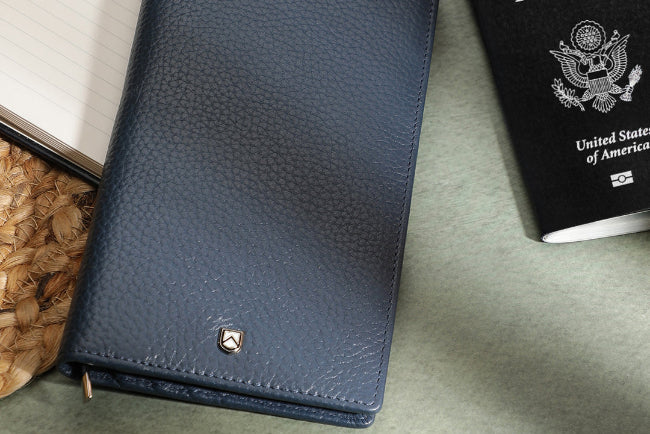
Moreover, a full-grain leather wallet ages gracefully by developing a distinctive patina; this ageing process darkens the color and gives a subtle shine to the wallet, adding to its unique character.
A full-grain leather wallet also holds its shape and structure very well, even after many years, sometimes even a decade. While a synthetic leather wallet collapses after a few months of usage, a full-grain leather wallet improves with age because its fibers stay dense and strong, and the stitching remains tight and intact.
The difference between a synthetic leather wallet and a full-grain leather wallet will be seen and felt within a few months of usage.
The Bottom Line
Instead of spending ₹800 - ₹1000 every few months and ultimately spending about ₹5000 or more in 5 years, it is best to choose a wallet that is made of high-quality full-grain leather that lasts more than 5 years and stays functional and relevant throughout the passing trends.
We always think carefully about quality before we buy a phone case, a sneaker or even a cup of coffee, but forget about the most important accessory in our hand, which is our wallet, our companion in everyday tasks. It gets the lowest budget without a second thought.
The real gap in thinking is not about spending more; it is about spending once and spending right.